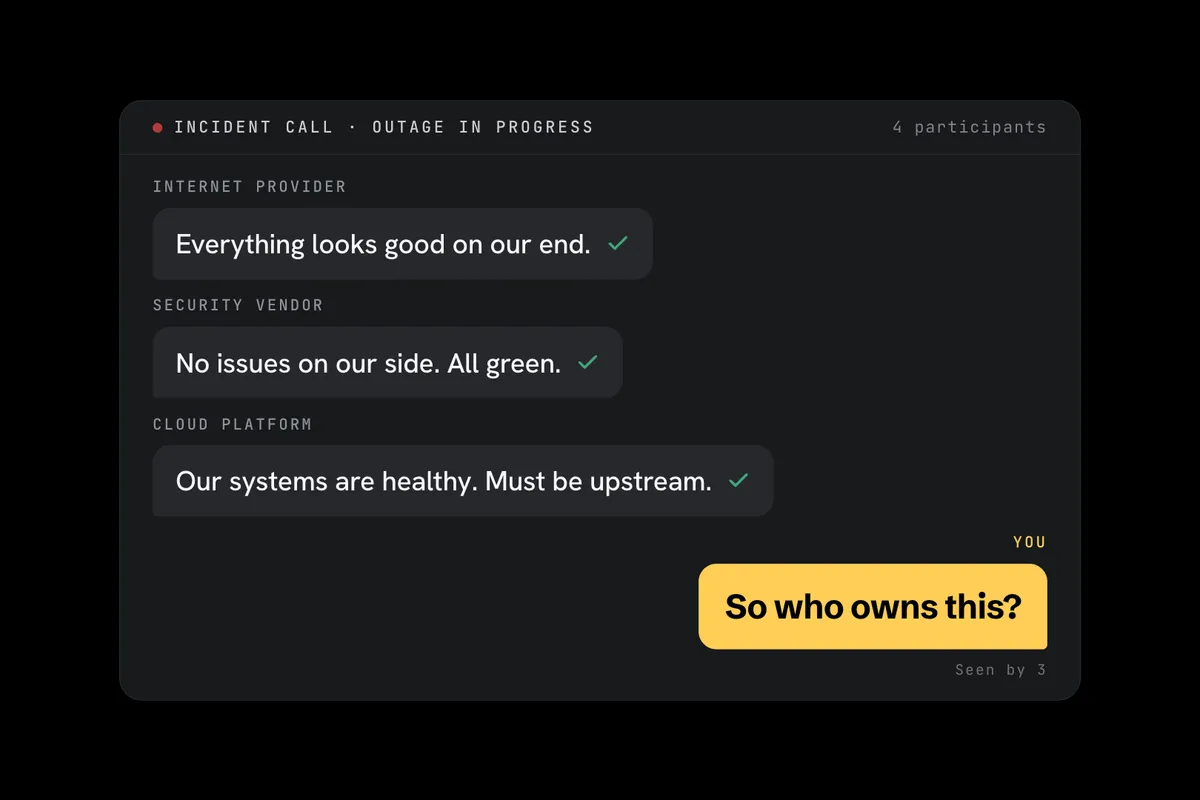
Every Vendor Said It Wasn't Them: Who Owns Your Technology?
The Short Version
If your organization has 50 to 250 people and an outside IT company, you pay someone to fix things. You may have nobody whose job is to decide things. More than a few growing organizations run that way. The gap stays hidden until an outage, a renewal, or a departure forces a decision no one owns.
When I led IT at a regional sports network, our VPN went down for a full week. Anyone working from home, or from our extension office a few states away, could not open a single file stored on our own servers unless they traveled to the main office.
On the incident call, every vendor on the line gave the same answer: their piece was working.
They were probably all telling the truth. Each one could show that its own system was healthy, and none of them was responsible for how the pieces fit together. I led IT, so the outcome was mine whether or not the failure was.
I think about that week whenever an owner or executive director tells me technology is covered because they have an IT company. The IT company is real, and usually good at its work. What I want to know is who plays my role on that call. At plenty of organizations your size, the honest answer is nobody.
Two Different Jobs
Fixing technology and owning technology are two different jobs, and it is common to pay for only the first one.
The fixing job is easy to see. A laptop dies, someone opens a ticket, and your IT company handles it. You pay a monthly fee, and most things work.
The owning job is quieter. It means deciding whether a renewal is still worth the money, and answering to leadership when two vendors point at each other. Your IT company can advise on those questions. It cannot decide them for you, and a good one will tell you that.
Here is what that job looked like for me.
A $35,000 Quote for Work My Own Engineer Could Do
A vendor quoted about $35,000 to replace the system our servers ran on before the old one's renewal came due. One of my engineers said he could do it himself, and he could have. We paid the vendor. They had done this kind of move before; if the switch went wrong, it was on them to fix it, and my engineer stayed on the work only he could do instead of spending weeks on the move. Nobody outside the building was going to weigh that quote against the cost of pulling him away, so I did.
Work Email on Personal Apple Accounts
Staff had set up personal Apple accounts with their work email addresses. That seems minor until someone leaves and you have to figure out who owns the account. We gave everyone 30 days to move those accounts off their work addresses. A vendor had no reason to catch it and no authority to set that deadline.
The Renewal Question
Every renewal I reviewed got the same question: would we buy this again today? Contracts tend to renew on their own when nobody is assigned to ask, and your IT company has little reason to raise it, especially when some of those renewals run through them.
Using What We Already Had
Before approving more storage, we reclaimed 2.2 TB of space we already had.
Departures
When someone leaves, HR handles the paperwork. Someone also has to make sure that person's access leaves with them, and those two steps belong on the same day. When different people own them, and nobody connects the two, access can outlast the job by weeks.
Signs the Job Is Empty
If you recognize a few of these at your organization, or at one you know, nobody owns this work.
An outage turns into a chain of emails where each vendor explains why it is not theirs.
Contracts renew every year and nobody can say what you get from them.
Someone left months ago and still has access to something.
Leadership asks a technology question, and the only person who can answer works for your IT company.
Staff started using AI tools on their own, and nobody decided whether that is allowed.
Your IT company can do its job well, and all of this can still happen because none of it is in its contract.
Where I Come In
I step into that seat as a fractional CTO. I do not replace your IT company. I work above it, on the decisions it cannot make for you, and I answer to your leadership or your board.
Work with me starts with a Technology Ownership Review, a three-week, fixed-fee look at who decides what across your technology and where nobody does.
If you recognized your organization in that list, start here: https://start.kenneththomas.com